Friday, 4 December 2015

Essay prep- Swamp Thing image analysis


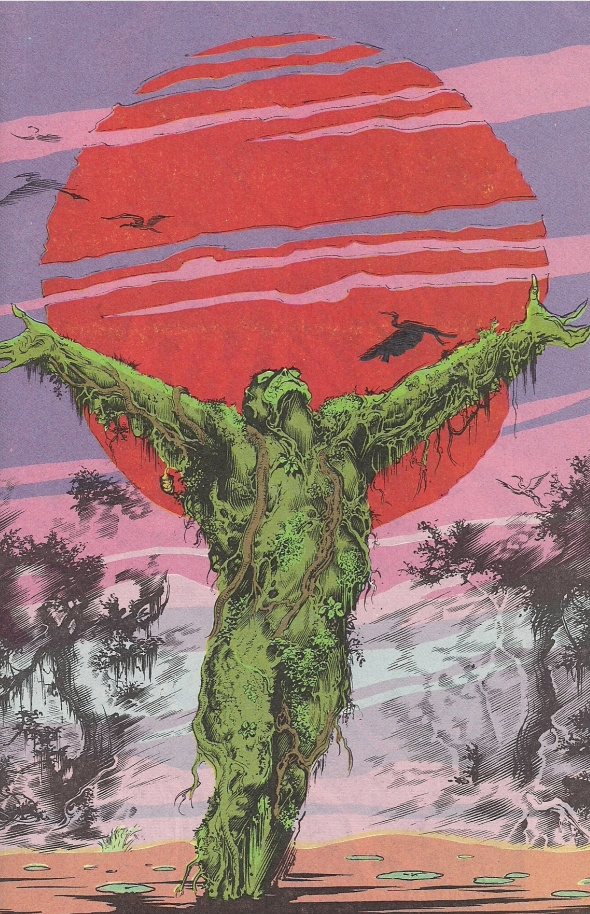
This image speaks to me of the duality of Alan Moore's Swamp Thing, as both a lover of nature and a defender of humanity. 

The colours of oranges and deep purple-reds in the piece represent peace and tranquility as it suggests imagery of a sunset, a time associated with beauty and calm. However, the phenomenon that actually causes this colour sensation is a form of air pollution that dilutes the colours of the sky at sunset. This fact creates a duality in the image, as the beauty of nature is ironically being influenced by the toxic touch of humanity. I believe this duality defines the whole character of Swamp Thing as a creature torn between humanity and nature. 

The obvious religious symbolism in this image echoes the crucifixion of Christ, as Swamp Things arms are outstretched and his head is thrown back, albeit without the actual cross being present. This suggests to the viewer that the character of Swamp Thing is a selfless defender, as mostly everyone is familiar with the concept of Jesus dying for the sins of humanity. This symbolism is continued with the deep red colours for the sun, as crucifixion is an event we as the viewer recognise as a bloody and brutal method. Contrast this christ symbolism with the green background with vibrant plants and animals populating it and the message becomes more concerned with rebirth than sacrifice. 

Thursday, 26 November 2015

Essay Prep - Watchmen image analysis

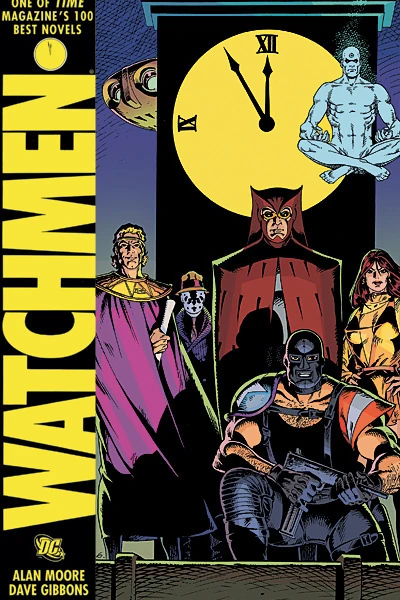
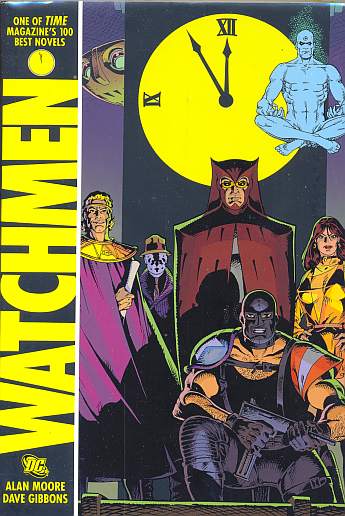
My chosen essay question is "discuss the tole illustration can play in periods of political and/or social upheaval", and the first thing I thought of when I chose this question was Alan Moore and Dave Gibbons' Watchmen graphic novel. While I plan to further explore the deeper themes of this novel as a complete piece of collected illustration in my essay, I wanted to prepare now by analysing the themes present in the cover alone.

Compositionally, I feel that this piece has a foreboding and confrontational nature as there are a lot of looming figures and shadows, all directed out of the page at the viewer. The small image of the airship 'Archimedes' in the top left corner peering around the clocktower represents the theme of being watched, as the message the book is based on; "who watches the watchmen", deals with ideas of loss of faith in structured government and personal ideals concerning national security and individual safety. The ship intentionally resembles an owl (and is named for Merlin's owl Archimedes from legend) to echo its ownership by the avain themed vigilante Nite-Owl, but also because the most prominent feature of an owl is the eyes, so the large eye shaped cockpit on the ship alludes to the plot being focused on watching and being watched.

The figure of Nite-Owl central to the piece also reinforces the idea of being watched as a central theme, as Nite-Owl is the primary source of information to the reader, as he is arguably the most naive character, so all we learn in the book we mainly learn from him, as he is always watching what is going on around him. The obvious similarities in design this character shares with Batman shine through in this image, informing the viewer that this is a story concerning vigilantism. However, the brown of his attire suggests to us that he is a 'good' character, as brown is a soft colour often associated with earth, nature and peace. Plus, the other characters surrounding him are much more garish.

Compositionally, this piece works to tell us of the downfall of the American Dream in modern post war society, as the figure of the Comedian is at the forefront of the image, but is the only character not stood up straight (or in the air). I think his crouched stance represents the weakness of the pre-war concept of the idealised American Dream, as he has Stars and Stripes inspired shoulder paldrons, illustrating who he clearly fights for. The American obsession with militaristic power is also addressed in his design, as he is cradling a machine gun, suggesting that perhaps this warmongering attitude is also weakened in 1980s society following ww2 and more fittingly, the Vietnam War.

Another figure that compositionally works to illustrate another theme of society in the 1980s comes in the shape of blue skinned Doctor Manhattan. The fact that this character is floating above everyone else is not only to allude to his superpowers in the narrative, or his superiority to the other characters due to his enhancements, but mainly to illustrate the looming threat of what he symbolises; the Atom Bomb. Following Hiroshima and Nagasaki, the world was taught the true power of nuclear warfare, and it immediately became a threat that loomed over the whole world, metaphorically and literally, as they literally fall out of the sky. Doctor Manhattans powers include things like energy manipulation, vaporising blasts, self duplication and physics bending quantum field manipulation. All of these over the top extreme virtually unstoppable powers are created to represent the explosive and unstoppable nature of the atom bomb, as there is no fighting it and no running from it once someone unleashes it upon you. Whilst his stance floating in a meditation position illustrates this characters detachment from humanity alongside his inhuman blue skin, I believe Gibbons has positioned him in this way to suggest the looming threat of nuclear annihilation hanging over not only all the characters heads in the narrative, but also real world society in the 1980s with tensions mounting between Russia and America.

The choice made by Gibbons in the ilustration of Ozymandias is interesting in this cover. He is garbed in purple and gold, to represent wealth and power, suggesting to the viewer the fact that he is a metaphor for Capitalism in the 20th century, ever expanding and convinced of its own self importance and ability to control the world. I only noticed the significance of the decision to place this character in the left of frame when studying it for this analysis. This positioning suggests to me perhaps an allusion to Ozymandias' deceit and ultimate betrayal of his fellow Watchmen and the ideals he seemingly represents throughout the narrative. Ozymandias is repeatedly described as a humanitarian, being the smartest man on earth and founding Veidt Enterprises as a megacorporation to help 'save the world', as he says. It is later revealed that he intends to save humanity from itself by defusing the conflict between the human race by using his vast wealth to stage a huge and horrible alien invasion that causes the death of millions, and unites humanity against this common enemy. I believe that this character being positioned on the left to suggest how he sees himself as a left wing socialist, acting selflessly for the good of humanity. And the narrative lets us believe this until he is revealed to be the architect of the invasion that kills millions. I see this image as a representation of the conflicting ideals of this character, as he cannot see the difference between selflessly saving the world and selfishly deciding what is best for everyone based on his own personal stance. This is a character that ultimately fits more in with right wing ideology of individual preservation and single person government, but his primary flaw is that he sees himself as a socialist hero of the world. I gathered this by not only the way he is positioned literally on the left, but also through his self righteous facial expression in comparison to the other figures.

The clockface in this piece represents again the looming threat of nuclear extinction, as it is set at five minutes to midnight. The metaphorical Doomsday Clock is a recurring theme in Watchmen, and is constantly being adjusted throughout the story closer and closer to midnight (midnight representing certainty of nuclear war on the Doomsday Clock). While yellow is often used as a colour of happiness or optimism, in this case it is subverted to represent danger and caution by catching the viewers eye. Overall in terms of colour, I believe Gibbons chose to use such a varied pallette of colours, light blue to brown to purple to yellow, to illustrate the different attitudes and themes raised in this book in response to the paranoia of the 1980s concerning mortality and war.

Finally, the character of Rorsach is barely explored in this image, but I believe this minimalism is deliberate to illustrate his detachment from the rest of the characters. His face is barely visible, but is clearly drawn to replicate a rorsach ink blot test. This character is a determined, brutal and unwavering vigilante with a strict set of rules that dictate his own perception of justice, and he is willing to kill to uphold these morals. The design of his mask is to illustrate this, as he lives in a world of black and white, with situations that shift and change like an inkblot test, but never, for him anyway, meld together into shades of grey.
Sunday, 15 November 2015

Swamp Thing - Modern Pastoral - William Blake similarities

Researching into the Alan Moore Swamp Thing comics, the sense of detachment from the natural world and longing for a return to nature is obvious throughout the series. This is, in English Literature, what usually defines a Pastoral text. William Blake, a Romantic poet, covered the same topics in his work, which he wrote in the time of the Industrial Revolution, where society was focused on technology's advancement and disregard for nature. And in the 1980s, this culture was very much at a height with the global focus on capitalism, and lack of investment into environmental concern. In this regard, contextually the works of Blake and Moore are responding to similar societies.


This panel is rooted (HAHA) in Pastoral motifs, the lamentation of man's arrogance and destructive capability, religion based values of an all powerful God, and the glimmer of hope that often comes at the end of a pastoral text,


These panels are indicative of Alan Moore's comparison between the Justice League and Western government. They are largely uninterested in the natural world until it starts to threaten their personal safety, and even then they are unprepared and don't know how to deal with it. Green Arrow's lament; "We were watching out for New York, for Metropolis, for Atlantis... But who was watching out for Lacroix, Louisiana?", defines how Western governments of the late 20th century were largely ignorant to the natural world, and how we as a species must now pay the price and rectify these mistakes.
This idea of making up for the protection of nature is prevalent throughout Moore's work on Swamp Thing, as it is largely a commentary on our modern apathy towards the natural world and continued focus on bigger and better.

Thursday, 12 November 2015

Essay - Swamp Thing

The concept of the Pastoral is a literary longing for the return of rustic English values and lifestyles, and a lamentation of the rapid industrialisation of the world. I studied the Pastoral at A Level in English, and it has been an important part of English development for hundreds of years, and I feel that it is still present today in the form of concern for our planet as a living natural thing independent of the human race.
A piece of Illustration that I feel captures the modern representation of the pastoral is Alan Moore's Swamp Thing.

The overriding theme of Alan Moore's run on the Swamp Thing comics is that of the natural world eventually overriding our technological and industrial constructs. As social responsibility concerning the environment is something that was not considered an important issue in the post war world that was trying to pick itself up and advance technologically, Swamp Thing was an exploration of the importance of nature, and the perceptions we as a society hold towards it.

Saturday, 31 October 2015

Essay Question Ideas - Superman: Red Son


Superman is a constant example of illustration responding to political and social upheaval since his creation in 1938. He has remained a symbol of American strength and idealism throughout the decades and the core values of his character can still be seen in his depiction in comics being printed in 2015. Mark Millar explores how this eternal beacon of "truth, justice, and the American Way" would develop had he grown up in Stalin's Russia, rather than cozy farmland Kansas. The story is for the character an exploration of nature versus nurture, and how different political ideals can shape a person's mind. It is interesting to see how in the regular DC Comics canon, the American people see Superman as an alien protector of humanity and hero, because he is one of them. But in this elseworld tale, the American government immediately labels him a "Red Menace", because he doesn't stand with them. While a lot of the comic is focused on the difference between a western dominated world and an eastern dominated world, Red Son is also an exploration of how geography and upbringing makes us perceive our heroes and villains. For example, the usually villainous Lex Luthor is the all American scientist hero to the American people, and the typically universally recognised as heroic Batman is a lunatic terrorist.
A connection to the real world I found while researching this is that of Che Guevara, hunted by the CIA as a terrorist and executed, but is now regarded by many disillusioned Western opinions to be some sort of socialist hero. While he did have triumphs for socialism, he was also primarily a soldier and killed a lot of people. The argument is basically the same as is presented in Red Son, and is one I want to get deeper into during my essay; what identifies a hero, and what constitutes a villain?

Essay Question Ideas - Quis custodiet ipsos custodes?

Translation - "Who watches the Watchmen?"

Watchmen is an example of graphic novels using alternate timelines and possible futures to illustrate elements of our world as they might have been. While V for Vendetta is focused on exploring primarily British 80s politics, Watchmen is centred entirely on the USA as it was in 1985. Since the development of the atomic bomb, the US has been cemented in its position as the superpower on planet Earth for two generations. Watchmen addresses the concerns of the time regarding the Cold War and ever mounting threat of a World War 3 that would last less than a few hours as we would all be obliterated basically immediately, the arrogance of America's actions in Vietnam, and concepts such as whether or not the needs of the many outweigh the needs of the few. Ultimately, the book is a response to the disillusion with government that arose in the 1980s, exploring multiple perspectives in regard to this, ranging from soldiers to businessmen to vigilantes to omnipresent gods.

Essay Question Ideas - V

The essay question I have chosen is
“Discuss the role that Illustration can play during periods of political and/or social upheaval."

I knew as soon as I saw the list of questions that I was going to enjoy this one the most, as there is nothing that simultaneously intrigues and pisses me off more than politics. One of the main reasons I wanted to study Illustration was to further explore and understand the role it plays in regard to how we develop as a society and a species over time. To me, illustrators are the modern equivalent of the jester in the King's court. This medium is one of the few that will always talk back regardless of who is in charge, and those in charge have never been able to stop us from doing just that. Just as the jester was allowed to say what he wanted without being executed as others may be, artists are allowed to say and express what they want about the world and nobody can cut our heads off either.


V For VendettaV for Vendetta is a look into a world that is basically our own but turned up to eleven, without all the pomp and pretense giving us the impression that we are 'free'. The idea that we are all free to do whatever we want is constantly presented to us in reality tv shows, advertisements and social media, when these are the very things that shackle us from doing anything but what we want. In this graphic novel Alan Moore presents a world that is controlled entirely by a fascist dictatorship, inspired by his experiences living in Thatcher's Britain. The book explores the idea of total freedom being ultimately terrifying, as much as we all may think it is what we want. The protagonist, Evey, remarks "It's just how life is. It's what we've got to put up with. It's all we've got. What gives you the right to decide its not good enough?" The 1980s were a time when a lot of people lost faith in their governments. mainly due to Thatcher and Reagan and the emerging focus on protecting number one and the death of community values. V for Vendetta shows us what could be possible if we were too to 'decide it's not good enough.'

The hacker group Anonymous uses the imagery and messages of V for Vendetta in its campaigns, and is a worldwide recognised organisation. Their ideology is an example of the social impact this graphic novel has had, inspiring millions to stand up and take action when they've had enough.


Sunday, 25 October 2015

Uncle Sam Range/Empire Marketing Board Analysis


"The Uncle Sam Range"


• The Uncle Sam Range advertisement features more prominent vibrant colours to draw the eye and give the impression of happiness and americanised satisfaction in relation to the stove product the advert is selling. However the section of the image featuring the little servant boy has distinctly darker colours, moving away from reds and golds into browns and greens, to suggest the insignificance or lower class of the boy, and his unimportance to the happy American family. The Empire Marketing Board is comprised of duller colours as it has a more serious message than trying to sell ovens, and is trying to communicate a sense of underdevelopment and perhaps unintelligence, as the piece suggests that natives of British colonies are only efficient and "useful" when under the guidance of powerful white British men.
• In the Uncle Sam Range advertisement the focus of the image is on the family "feeding the world", as Uncle Sam is there to represent America, and one of the children wears a hat that says Britain to signify that Britain is an ally of America and supports their ventures. Off to the left is the image of the black servant boy, alone, crouched and very separate to the family as he appears to be hiding behind the oven. To me his inclusion in the piece in this manner suggests to the audience that having a servant is a sign of wealth and importance but treating them as anything other than property or tools is pointless. This is due to the boys placement in the piece amidst all the kitchen equipment and the fact that the colours surrounding him are dark Browns and blacks, suggesting he is just another appliance. In the Empire Marketing Board, in the first image, the tribe is shown travelling in a single file line with a mix of both men and women, suggesting a hierarchy based on skill at hunting and gathering, irregardless of sex. However, in the second image there are only men, all working beneath the proud stance of the white man on the left. There are also significantly more figures in the first frame, and they are all sharing the load equally and each carrying what they can manage. In the second frame, the men are all struggling with bigger heavier objects while the white man 'supervises' them. It is interesting to know that these posters are intended to advertise taking over colonies as a good thing, but only for the White Man in the frame as he is the only one doing no work. 
• both these pieces would have similar audiences; upper class white men, but where the Uncle Sam Range appeals to its audience on a consumerist level, the Empire Marketing Board appeals to its audience on a socio-economic level. The Uncle Sam Range suggests to its audience that rich white Americans can have and deserve to have the latest technology in their homes. While there is a vague suggestion that everyone in the world also deserves this privilege with the globe man sat at the dinner table, all the real people who are getting fed are upper class looking white people. This suggests to the audience that while this range might be "feeding the world", they will be the first to receive the technology as they apparently deserve it for being part of advancing consumerist America. Conversely, the Empire Marketing Board reaches out to its audiences sense of nationalism and personal pride. By showing a tribe slowly gathering supplies contrasted with an industrialised method of work under the supervision of white men it is suggested to the audience that the attitudes of the western world are indicative of the future and the primitive colonies are in need of desperate revolutionising to become more like the clever, technologically advanced nation of Britain. Although now this attitude seems arrogant and imperialistic, at the time of this piece's creation it would've been the agreed general attitude to colonies and British expansion. The piece also gives its audience a sense of personal empowerment as they can picture themselves as the powerful white man as the piece suggests he represents all of Britain. 

Wednesday, 7 October 2015

Study Task 1 - Political

Definition:
"Of or relating to the government or public affairs of a country: a period of political and economic stability.
Relating to the ideas or strategies of a particular or group in politics: a decision taken for purely political reasons.
Interested in or active in politics: I'm not very political.
Motivated by a person's beliefs or actions concerning politics: a political crime.
Done or acting in the interests of status or power within an organisation rather than as a matter of principle."

Quote:
"Capitalism; God's way of determining who is smart, and who is poor." - Ron Swanson, Parks and Recreation (Nick Offerman)

Photograph: A photo from the JFK assassination, a dark and sad moment in political history but also deeply intriguing and strangely mysterious. This photo was long thought to depict Jackie Kennedy trying to escape the car but it has been discovered since that she was actually trying to retrieve the top part of her husbands head. (As depressing as this photograph is, I feel like the whole situation is so interesting due to its politically charged nature and extremity)
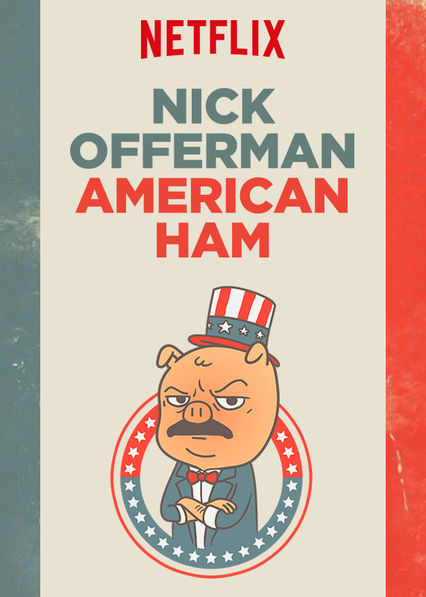
Image: Cover for Nick Offerman's comedy stand up American Ham, which is a show charged primarily by Offerman's distaste for faceless government and the selfish attitudes in individuals they create, and his desire for people to just "give a crap" about one another as people rather than as drones or masters or providers or consumers. The illustration of Uncle Sam as a little pig is firstly a joke towards Offerman's mustached appearance but also a jab at his dislike of American politics and the greedy nature it feeds into the political system.

Study Task 1 - Cultural

Definition:
"Relating to the ideas, customs, and social behaviour of a society of a society: the cultural diversity of British society.
Relating to the arts and to intellectual achievements: a cultural festival."

Quote:
"Culture is the intersection of people and life itself. It's how we deal with life, love, death,birth, disappointment... all of that is expressed in culture." - Wendell Pierce

Photography: Glastonbury 2013 crowds at the Pyramid Stage, representative of youth culture and musical culture that personally have had a significant impact on my development and understanding of myself and others.

Image: One of the covers for Alan Moore's Watchmen, a cultural commentary of the various different aspects of American government and American people in the closing decades of the 20th century. The characters in this novel are the primary form of commentary on American culture through their differing personalities. The loud brute, The Comedian represents America's military strength and arrogance concerning both WW2 and the Vietnam War, through his gung-ho attitude and love of physical violence. The stoic and unwavering Rorschach represents the attitude of black and white morality (showcased by his ever changing in pattern but constantly black and white coloured mask) fading in an age defined by grey areas in morality and American culture. Rorschach is unwilling to compromise with modern ideals and is out solely to punish the guilty and defend what he perceives as justice. Ozymandias is the parallel to rapidly expanding 20th century capitalism, becoming strong enough to control everything from what brand of soap people buy, to the literal nuclear apocalypse.  Dr Manhattan represents a part of American culture that survives still today and is the main reason America's culture revolves around it being the strongest nation on the planet; nuclear firepower. Dr Manhattan's physics defying powers are a metaphor for America's A-Bomb, which the world lived in constant fear of since seeing its destructive capabilities in the closing months of World War 2. All of these characters present a different representation of different aspects of American culture, and the dangers of how these elements of culture intersect and clash. (I think I wrote too much but I could write about Watchmen for days.)

Study Task 1 - Technological

Definition:
"Relating to or using technology: the quickening pace of technological change.
Technology - the application of scientific knowledge for practical purposes, especially in industry: advances in computer technology.
Machinery and devices developed from scientific knowledge. It will reduce the industry's ability to spend money on new technology.
The branch of knowledge dealing with engineering or applied sciences."

Quote:
"Change creates fear, and technology creates change. Sadly, most people don't behave very well when they are afraid." - Daniel H Wilson

Photograph: Virtual reality headset; if this is the future of experiencing the world I don't see the point.
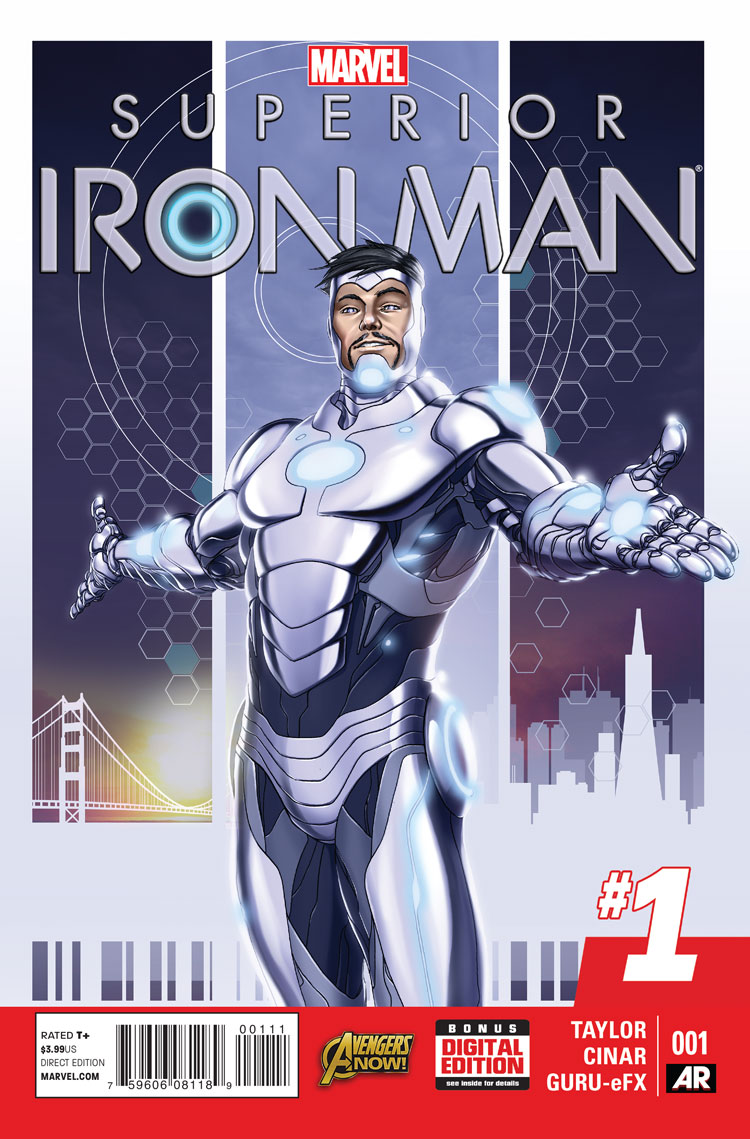
Image: Superior Iron Man issue 1, recent reinvention of the famed character Tony Stark wherein his personality is reversed by the telepathic powers of Red Onslaught (Nazi scientist Red Skull possessing the brain of X Men founder Charles Xavier to become a 50 foot armored skull tentacle monster, comics logic) and he develops a worldwide technological interface called Extremis (representative of Apple in our world) that appears to connect everyone but really just profits Stark and increases his own technology based power. The series as a whole is a social commentary on our dependence on modern, white, sleek looking technology and appliances and how it can warp us as people. The white liquid metal Mark 51 Iron Man suit established in this issue also works as a dark parody and warning of what our ever encompassing smartphones might one day evolve into.

Study Task 1 - Social

Definition:
"Relating to society or its organisation: alcoholism is recognized as a major social problem / the social structure of Europe had become more fluid.
Relating to rank and status in society: a recent analysis of social class in Britain / her mother is a lady of the highest social standing.
Needing companionship and therefore best suited to living in communities: we are social beings as well as individuals.
Relating to or designed for activities in which people meet each other for pleasure: Guy lead a full social life / staff facilities included a social club and leisure complex."

Quote:
"Society exists only as a mental concept; in the real world there are only individuals." - Oscar Wilde

Photograph: This Is England film cover, an enlightening commentary on life and changing social values in northern England during the early 1980s.
Image: Luke Cage issue 1, one of the earliest african american heroes represented in Marvel comics, created to show support for racial equality and the Civil Rights Movement in 1960s America.

Study Task 1 - Historical

Definition:
"Of or concerning history or past events: historical evidence.
1) belonging to the past: famous historical figures.
2) (especially of a novel or film) set in the past.
3) (of the study of a subject) based on an analysis of its development over a period: for the Darwinians, bio-geography became a historical science.

Quote:
"History repeats itself, first as a tragedy, second as a farce." - Karl Marx

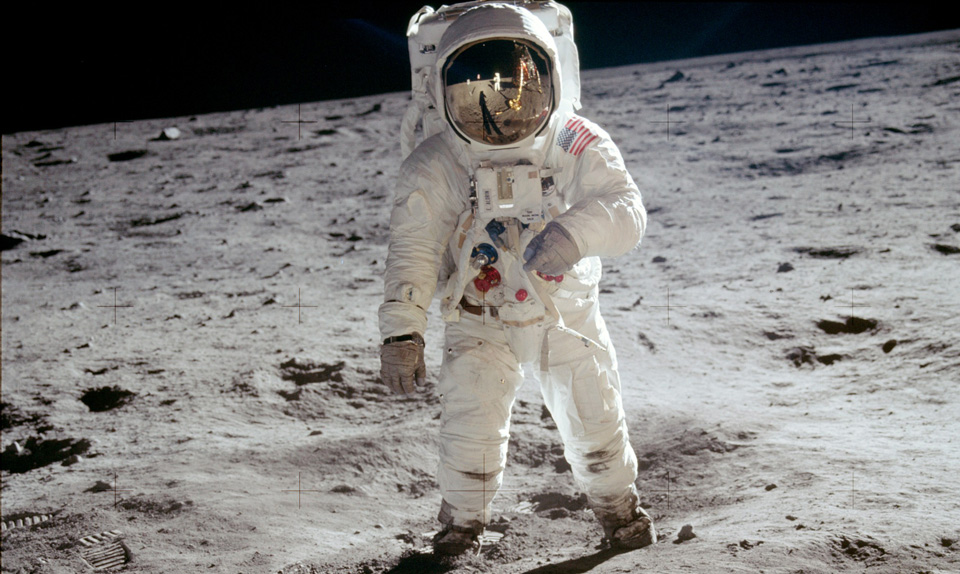
Photograph: The moon landing, one of the most significant explorations in the history of the human race, our first physical step into a wider universe.
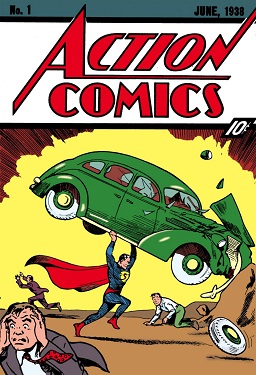
Image: Action Comics 1, recently became the most valuable comic book in history selling for over 3 million dollars.