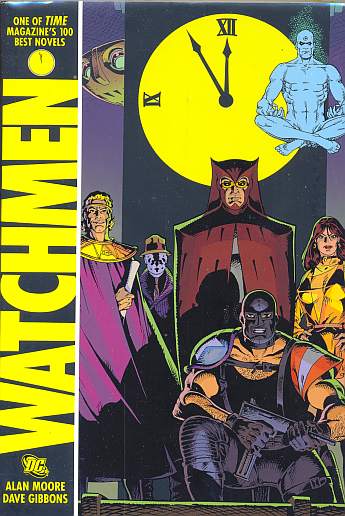
 My chosen essay question is "discuss the tole illustration can play in periods of political and/or social upheaval", and the first thing I thought of when I chose this question was Alan Moore and Dave Gibbons' Watchmen graphic novel. While I plan to further explore the deeper themes of this novel as a complete piece of collected illustration in my essay, I wanted to prepare now by analysing the themes present in the cover alone.
Compositionally, I feel that this piece has a foreboding and confrontational nature as there are a lot of looming figures and shadows, all directed out of the page at the viewer. The small image of the airship 'Archimedes' in the top left corner peering around the clocktower represents the theme of being watched, as the message the book is based on; "who watches the watchmen", deals with ideas of loss of faith in structured government and personal ideals concerning national security and individual safety. The ship intentionally resembles an owl (and is named for Merlin's owl Archimedes from legend) to echo its ownership by the avain themed vigilante Nite-Owl, but also because the most prominent feature of an owl is the eyes, so the large eye shaped cockpit on the ship alludes to the plot being focused on watching and being watched.
The figure of Nite-Owl central to the piece also reinforces the idea of being watched as a central theme, as Nite-Owl is the primary source of information to the reader, as he is arguably the most naive character, so all we learn in the book we mainly learn from him, as he is always watching what is going on around him. The obvious similarities in design this character shares with Batman shine through in this image, informing the viewer that this is a story concerning vigilantism. However, the brown of his attire suggests to us that he is a 'good' character, as brown is a soft colour often associated with earth, nature and peace. Plus, the other characters surrounding him are much more garish.
Compositionally, this piece works to tell us of the downfall of the American Dream in modern post war society, as the figure of the Comedian is at the forefront of the image, but is the only character not stood up straight (or in the air). I think his crouched stance represents the weakness of the pre-war concept of the idealised American Dream, as he has Stars and Stripes inspired shoulder paldrons, illustrating who he clearly fights for. The American obsession with militaristic power is also addressed in his design, as he is cradling a machine gun, suggesting that perhaps this warmongering attitude is also weakened in 1980s society following ww2 and more fittingly, the Vietnam War.
Another figure that compositionally works to illustrate another theme of society in the 1980s comes in the shape of blue skinned Doctor Manhattan. The fact that this character is floating above everyone else is not only to allude to his superpowers in the narrative, or his superiority to the other characters due to his enhancements, but mainly to illustrate the looming threat of what he symbolises; the Atom Bomb. Following Hiroshima and Nagasaki, the world was taught the true power of nuclear warfare, and it immediately became a threat that loomed over the whole world, metaphorically and literally, as they literally fall out of the sky. Doctor Manhattans powers include things like energy manipulation, vaporising blasts, self duplication and physics bending quantum field manipulation. All of these over the top extreme virtually unstoppable powers are created to represent the explosive and unstoppable nature of the atom bomb, as there is no fighting it and no running from it once someone unleashes it upon you. Whilst his stance floating in a meditation position illustrates this characters detachment from humanity alongside his inhuman blue skin, I believe Gibbons has positioned him in this way to suggest the looming threat of nuclear annihilation hanging over not only all the characters heads in the narrative, but also real world society in the 1980s with tensions mounting between Russia and America.
The choice made by Gibbons in the ilustration of Ozymandias is interesting in this cover. He is garbed in purple and gold, to represent wealth and power, suggesting to the viewer the fact that he is a metaphor for Capitalism in the 20th century, ever expanding and convinced of its own self importance and ability to control the world. I only noticed the significance of the decision to place this character in the left of frame when studying it for this analysis. This positioning suggests to me perhaps an allusion to Ozymandias' deceit and ultimate betrayal of his fellow Watchmen and the ideals he seemingly represents throughout the narrative. Ozymandias is repeatedly described as a humanitarian, being the smartest man on earth and founding Veidt Enterprises as a megacorporation to help 'save the world', as he says. It is later revealed that he intends to save humanity from itself by defusing the conflict between the human race by using his vast wealth to stage a huge and horrible alien invasion that causes the death of millions, and unites humanity against this common enemy. I believe that this character being positioned on the left to suggest how he sees himself as a left wing socialist, acting selflessly for the good of humanity. And the narrative lets us believe this until he is revealed to be the architect of the invasion that kills millions. I see this image as a representation of the conflicting ideals of this character, as he cannot see the difference between selflessly saving the world and selfishly deciding what is best for everyone based on his own personal stance. This is a character that ultimately fits more in with right wing ideology of individual preservation and single person government, but his primary flaw is that he sees himself as a socialist hero of the world. I gathered this by not only the way he is positioned literally on the left, but also through his self righteous facial expression in comparison to the other figures.
The clockface in this piece represents again the looming threat of nuclear extinction, as it is set at five minutes to midnight. The metaphorical Doomsday Clock is a recurring theme in Watchmen, and is constantly being adjusted throughout the story closer and closer to midnight (midnight representing certainty of nuclear war on the Doomsday Clock). While yellow is often used as a colour of happiness or optimism, in this case it is subverted to represent danger and caution by catching the viewers eye. Overall in terms of colour, I believe Gibbons chose to use such a varied pallette of colours, light blue to brown to purple to yellow, to illustrate the different attitudes and themes raised in this book in response to the paranoia of the 1980s concerning mortality and war.
Finally, the character of Rorsach is barely explored in this image, but I believe this minimalism is deliberate to illustrate his detachment from the rest of the characters. His face is barely visible, but is clearly drawn to replicate a rorsach ink blot test. This character is a determined, brutal and unwavering vigilante with a strict set of rules that dictate his own perception of justice, and he is willing to kill to uphold these morals. The design of his mask is to illustrate this, as he lives in a world of black and white, with situations that shift and change like an inkblot test, but never, for him anyway, meld together into shades of grey.


