Saturday, 3 December 2016

Post-Modernist Design Theory - Lecture 30/11/2016

1970s - established as term (Jencks)
1980s - recognisable style
1990s - dominant theoretical discourse
Now - tired & simmering

Jean Francois Lyotard - The Postmodern Condition (1979)

Incredulity towards meta-narratives (Modernism, Marxism, Christianity, Science, etc)

Homogenising forces give way to heterogeneity - Result: CRISIS IN CONFIDENCE - not knowing where society is headed
Modernism is largely driven by white men

Postmodernism is more broad:
Phillip Johnson - The AT&T Building
Image result for at&t building philip johnson postmodernism

Memphis Group
Image result for memphis group clocks

Ettore Sottass
Image result for ettore sottsass


Masanori Umeda
Image result for masanori umeda


Postmodernism questions the supposed neutrality of universalism that Modernism claimed to strive for

Patriarchy is still very much in power - more subtly today through ingrained ideas and attitudes
The Story of Art - E.H. Gombrick - didn't mention a single woman in the history of ALL art
History is largely built with a patriarchal bias
Postmodernism strives to destroy this bias

Jacques Derrida - Of Grammatology - suggests that all of philosophy and history up to now has been flawed because it has been focused on setting up binary opposites within everything - Man v Woman, Black v White, Good v Bad - the world is more complex
|
these binaries are set up to make one seem more appealing than the other
Man     :    Woman
White   :    Black
Speech :    Writigng
Voice   :    Silence
Culture :    Nature
West     :    East
Present :    Past

All these binaries work to make the second one seem inferior, e.g the connotations of white vs those of black

Logocentrism - tipping the favour of a comparison - one is suggested to be superior

Derrida, J (1974) - Glas - the strange structure of the book makes the reader responsible for connecting the dots and authoring the book themselves


Cranbrook Academy- 1975-1991 - Director Katherine McCoy
Image result for cranbrook academy prospectus director katherine mccoy

David Carson-Raygan (1994) - Interview with Bryan Ferry printed in incomprehensible Wingdings font because he thought Ferry was boring, so why would anyone want to read the interview

Martin Margiela (2003) - Tweed blazer with lining showing: deconstructive=little rebellions - a jacket that turns itself inside out when you put it on - rebellious, but not collapsing social boundaries


St Martins Fashion Show - deconstructive fashion
Image result for st martins fashion show
Related image

Body Meets Dress, Dress Meets Body - the opposite of necessity & Modernism's desire for ultra-sleek everything to make life easier - clothes that wear you: goes directly against Form Follows Function
Image result for body meets dress dress meets body

Issey Miyake (1999) - A Piece Of Cloth - feels like a mockery of Modernism, deconstructing the single material foundation of Modernist design
Image result for issey miyake a piece of cloth

Helene Cixous (1967) - The Laugh of the Medusa
Man       :   Woman
Active   :   Passive
Sun        :   Moon
Rational :  Irrational
Culture  :  Nature
Head     :  Heart
Father   :   Mother
|
Logocentrism - all the privileged concepts are made out to be male
Phallogocentrism - Still tipping the favour but very much towards the male dominated elements

Edward Said (1978) - Orientalism - STILL tipping the favour towards males, but very much towards western males - the East is described as less dominant, as women are
West      :    East
Familiar :    Exotic
Safe        :    Dangerous
Moral     :    Amoral
Rational  :   Irrational
Head       :   Heart
Culture   :    Nature
Science   :    Myth

All these things become ingrained and become justifications for colonialism, racism, sexism etc
Not even technically propaganda because its SO ingrained in peoples minds its almost an involuntary thought process for most people
This isn't how things are - women are not genetically inferior, eastern culture isn't magical - its BIAS enforced by the patriarchy - Postmodernism's desire is to uncover and expose this
The bias doesn't really stand up to scrutiny - the continuation of the patriarchy and powerful white men controlling everything depends on normal people telling themselves they belong at the bottom- the most effective prison is that in which the prisoners exist willingly

Pastiche - Stagnation - no change happens and nobody cares about it
Depthlessness = nostalgia for false past - false realism

Hopelessly commercial - there's no way for you to be outside of anything - everything is collapsed in together
Memphis Design - Has now become capitalised and has no real content - just meaningless patterns design for production and sale

Nirvana shirts being recycled on the high street - no understanding or respect for the anarchist context that symbol was born in, and what its creators were saying - this is how all these biases are produced - through laziness and ignorance, retro without context, content without substance, lack of grounding
Affirmative Culture - affirms and conceals the real conditions of social existence

The solution to hegemony is deconstruction - show people what is really there
All these rebellious images and phrases are everywhere but the public don't know why and don't care why, so it means nothing

Man depends on woman to stay in the place they have assigned them to ensure the continuation of the patriarchy
Writing is more permanent than speech
The resources of the East are depended on by the West
|
DECONSTRUCTION OF BIAS

Sonia & Robert Delawney - Both have the same style of working:
Robert said to have a systematic understanding and approach to colour
Sonia said to have a 'feeling' for colour
Subtle Sexism

76% of us in LCA are women, going into an unstable(ish) arts industry
94% of engineering students are male, going into a secure, constant, well paid industry
The opportunities need to be readily available to all or the stagnation will continue

Deconstruction is the key

Friday, 25 November 2016

Modernist Design Theory - Lecture 23/11/2016

Form follows function - link to The Cog


Technology
Anti historicist - doesn't look backwards for a solution, embraces the new

15th July 1972 - 3:32pm - the date and time of the death of Modernism, according to Charles Jencks, with the demolition of the Pruitt-Igoe block
Modernism tried to change the world for the better

Helvetica documentary by Gary Hustwit

Van Doesburg (1929) - Simultaneous Counter-Composition
Manifest of "The Style" 1918:
Devoid of nationalist/individualist interests - petty politics

Beatrice Wade (1932) - The Crystal Goblet
- if wine is what you love, you don't care about having a fancy cup to drink it out of
- metaphor for Modernist design - humility - modernist design shouldn't be greedy or noticeable - should just do what it is made to do, and in doing so improve the world

This is a Printing Office

Massimo Vignelli
The life of a designer is the life of a fight - a fight against ugliness, aesthetic and social
Modernist design is lasting, post-modern design quickly fades as it desperately tries to be relevant in the moment it is created
Modernist has timeless values
People can't really get behind cynicism and sarcasm forever - especially when it isn't making the world any better

Experimental Jetset
Modernist design practices combined with pop culture
Disrepresentation
Anti-Tendenkunst - against art tendencies
The process of representation = anti revolutionary (representative art - portraits etc) inherently bourgeoise
representative cultural communication - propaganda etc = art that tells you something: how to think, who is good, who is bad, who to be, what to like, what to buy
Modern art doesn't tell you anything or to do anything - it just exists and is shared

People who tell you to 'free yourself' from the MAN & capitalism still adhere to advertising, they are trying to convert you to their way of thinking
Abstraction - a move away from realism but towards reality - the ultimate, most raw form of engagement
Workers of the world, unite - Marx
Pirates of the internet, unite - Experimental Jetset
First Things First Manifesto

BAUHAUS
Disciplinary specialisation is another form of social alienation - a collective struggle is better than an individual one - interdisciplinary collectivism

Paul Klee - Pedagogical Sketchbook (1925)
Wassily Kadinsky - Point and Line to Plane (1926)
Gyorgy Kepes - Language of Vision (1944)
Lazlo Moholy-Nagy - Vision in Motion (1947)

The Bauhaus principles are why the Nazis shut it down - they didn't believe in a universal language and collective progress, they believed in Germany first forever

Marinetti, F.T - The Manifesto of Futurism - anti-Bauhaus
basically far right wing modernism - no beauty without violence or aggression
war is the only way to create a pure world - they wanted to fight "every opportunistic or utilitarian cowardice"
technological destruction, ethnic cleansing, fascism
"war is beautiful because it enriches a flowering meadow with the fiery orchids of machine guns"
fighting for a new (horrible sounding) future
fiat ars - pereat mandas

Walter Benjamin - Humanity is so alienated with itself it can experience its own destruction as an aesthetic pleasure of the first order.


Thursday, 10 November 2016

Decisions + change of direction

This year I wanted to focus on themes of society and possibly technology, as I focused a lot on political aspects last year. One of my main reasons for this change of direction was because investigating into politics, while I enjoy it and find it worthwhile, frustrates and challenges me. After some thought, and my investment in following the American election only to be horribly disgusted and infuriated by the result yesterday, I've decided I need to use my frustration to fuel a historically and politically charged exploration of visual culture. What's the point of making work if it doesn't have some form of strong feeling or message behind it? Mainly rage.

I've been primarily looking into American politics, namely how the nation was formed (or stolen), unified (sort of) and how it has changed into what it is today. The War for Independence is very interesting to me as it was fought by men who wanted to forge a country for free people, and factions of the American people have since continuously worked throughout history against this morale, dividing and segregating for years based on hundreds of varying prejudices, often times saying they are enforced by the Constitution, written largely by men who wanted liberty and freedom from the yoke of corrupt monarchy.
Oil paintings of battles and figureheads are the primary form of visual communication from this time, alongside tomes of accounts, recollections, battle plans, interviews etc. I want to investigate the relationship between the written and the visual in terms of historical accuracy and representational value.

A massive inspiration for me in choosing this topic has been the Broadway musical, Hamilton, which illustrates the history of Alexander Hamilton, one of the founding fathers, whose life was peppered with danger, genius, acclaim, romance, disgrace and tragedy. His relationships with the men who forged modern American government and his contribution to it were often overlooked in the historical accounts of the time, mainly because a lot of his contemporaries desired to better themselves rather than giving him and his allies the credit. Names like Thomas Jefferson are more famous and renowned than obscure names such as Hercules Mulligan, Cato or Marquis de Lafayette, although the continuation and security of American independence are owed largely to the three latter figures.

This is an element I want to explore in this module, how history is very much written by the victors, but today we all have a voice to express how we individually feel and respond to events, and how this will affect how history is documented in the future, especially with politically charged illustration, design, film, music and other forms of creative expression being prevalent in today's society. After all, it was this musical that enlightened me on various figures and events that I wasn't previously aware of, rather than a history book - my first bit of proof that creative expression is today a much more influential tool than traditional methods of information reception.


Wednesday, 9 November 2016

Core Texts - Animation - Lecture 9/11/2016

Marx concept of base/ superstructure


                          Determines content & form of it
                          /                                              \
                         /                                                 \
                      Base                                    Superstructure
                         \                                               /
                          \                                             /
                            Reflects form & legitimises

The Frankfurt School
Dialectical materialism + culture as an industry - formulaic production without purpose or integrity - homogenous and predictable

  • Deceived masses - caught in a circle of manipulation & retroactive need in which the unity of the system grows ever stronger - people depend on it
  • Satiates superficial needs, which prevents the formation of more fundamental designs
Fordism - factory style churning our faster and faster - lose the capability to know what you're even making - instead of one person making a car, thousands of people make one bit of a car each over and over again

Adorno:
Standardisation - to conceal this - pseudo-individualisation - easy to produce, easier to consume = social cement
Creates passivity - rhythmically obedient and emotional types - popular music industry is a pacifying agent to keep people obedient and too passive to know what's happening
Promotes psychic adjustment to the prevailing power structure
PASSIVE CREATION
(Dancing to the rhythm of your own oppression) 

Nobody is encouraged to do anything new or risky because the public are too stagnated and ignorant to accept it (I'd like to say these are the views of Adorno, I aren't ranting (I am a little) )
Adorno believes people conform because there is no other option 

Marcuse:
Popular culture vs Affirmative Culture
Culture affirms & conceals the new conditions of social life
Authentic culture: 
  • Real
  • Multi-dimensional
  • Active consumption
  • Individual creation
  • Imagination
  • Negation
  • Autonomous

    TV, Films, music, art - can be all these things
Walter Benjamin:
The Work of Art in the Age of Mechanical Reproduction - 1936
The culture of the masses CAN be meaningful
The message of something is not determined by its production but by its consumption - we can resist to change and play with what we take in - a form of rebellion
Liking things for personal creative reasons - role reversal, irony, mockery, rebellion, playfulness, FUN

Dialectical materialism - changes in the substructure (advancements in technology, print methods etc) have radically changed the superstructure 

AURA = Presence, Authenticity, Authority
AURA:
  • Creativity
  • Genius
  • Eternal value
  • Tradition
  • Authority
  • Authenticity
  • Autonomy
  • Distance
  • Mystery
KEY CONCEPTS:
  • Aura
  • Culture Industry
  • Dialectical materialism
  • Technology
  • Originality
  • Cult Value
  • Exhibition Value
  • Auratic culture to democratic culture
"I'm sorry I'm so worthless and you're so great" - art gallery and museum thinking - gives way to Fascist acceptance
The fact we can alter and change existing art gives us power over it - laughs at its supposed authority & take back control for ourselves (by drawing devil horns on the Mona Lisa)
The work of art reproduced becomes made for the purpose of REPRODUCTION - art/feeling as a commodity
Art responds as art - becomes abstract + spiritual
Filmmaking is collaborative - always involves a team - can create creative methods of consumption - rebels against social authoritarianism 

Monday, 7 November 2016

Research Task - Images and Theory - Commodity Fetishism

Idea derived from Marx (Capital: Volume 1) - inanimate things are seen to have value by themselves
Commodities only have any value because we put meanings and values upon them

Money isn't actually physically worth anything - everyone and everything says that it is the most necessary and precious thing so it has become just that

Intrinsic human quality - every society since humans were intelligent enough to form them has been centred on one form of currency or another. In some places, money is a digital number uploaded into a database that doesn't exist in the physical world, and can be converted into paper and metal coins by way of a plastic card with a microchip in it that goes into a box built into the side of a building. And in other places, money is a goat.
- humans will always have to place value on something to drive them

There are a thousand guards guarding one king, but because they are told he is in charge, they are unable to take control, although they are more numerous and powerful together. Power resides where people believe it resides. Belief is more influential than proof because it is easier, less harsh or difficult to accept, and can be altered to people's personal preferences. This is why religion exists and why people are so fiercely protective of it, disproving someones religion is tantamount to tearing their perception of the world in half, which is obviously terrifying.

Value is a social relationship
Commodification of classic art - the Mona Lisa - everyone thinks it is great BECAUSE everyone thinks it is great. There is just an objective consensus that it has a quality, fuelled primarily by its fame.
Banksy - messages about anti-capitalist thinking have been taken and printed and sold on mugs and pillows and shit. People have been so blinded by feckless and empty adoration for something they know is popular they have missed the entire point of what they are looking at. Some of the people who have paid thousands to own the work are actively working against the anti consumer message of it in their daily lives. Ripping people off on loans and mortgages all day in a bank and coming home to a Banksy painting hanging in your living room is almost hilariously ironic and equally tragic, that the art has become castrated and diluted by its own popularity.

There is no relationship between production value and sale value - a name/brand will always drive prices up because people will pay much more to ensure that other people know that they can afford whatever brand it is. Consciously or not, we are conditioned to assume that because one jumper has an Italian mans name on it, it is a more prestigious jumper that will improve our lives, improve how others see us, ultimately completing us. And when it inevitably doesn't, we become bored and desire some other thing that definitely will.

Christmas has gone through several forms of commodification for one reason or another:
  • Begun as a Pagan festival celebrating the winter solstice - as less work had to be done in the winter, and the people had the spring weather to look forward to
  • Norse culture also had a festival called Yule, based around Odin going on a hunt through the sky
  • Christianity eventually took over the time period and absorbed most of these other western religions into itself and redeveloped the time as Christmas, celebrating the birth of Christ
  • As society became less controlled by religion, the meaning of Christmas began to focus on presents and the commodities of Christmas, and this has continued and amplified significantly in the last few decades - almost all religious imagery is absent from Christmas celebrations and half the people who celebrate it call it Xmas - the beginning of a new phase where capitalism has taken the place of the church absorbing all those religions and cultures, and successfully usurped the holiday and converted all its followers.


THEORIES for further research

  • Character Mask
  • Commodity (Marxism)
  • Exchange Value
  • False Consciousness
  • Law of Value
  • Labour Theory of Value
  • Real Prices and Ideal Prices
  • Reification
  • Relations of Production
  • Use Value
  • Value Form
Reification - similar - giving non physical/real things attributes and worth, such as fear or the concept of money etc - e.g. a wedding ring being more than a band of metal, now a physical signifier of love and commitment

Warhols soup cans - they were being printed in his studio "The Factory", he wasn't even physically doing the printing - is the work even his? 
He produced them like this to illustrate that they are worthless - but people saw his name on them and immediately imprinted a value and a worth on them because his work was famous - they don't care what he was trying to say or what the message of the work is, as long as it is labelled in a way that will make them look or feel more important for having paid through the nose for it, it has a much higher value. 


Wednesday, 26 October 2016

Research and Epistemology Part 2 (Electric Boogaloo) - Proposing a Research Project - Lecture 26/10/2016

Assimilation -------- General Study
        |                                    |
        |                                    |
Development --------- Communication

"Research is formalised curiosity.
It is poking and prying with a purpose" - Zora Neale Hurston

FACTS (truth) + OPINIONS (beliefs) = KNOWLEDGE

We are the centre of our research and therefore have to drive it forwards.

Monday, 24 October 2016

Establishing a Research Question

Suggested Research QuestionI want to explore the different ways visual communication (on multiple levels) can be used to orchestrate, manipulate, influence and deter societal change
(something like that)

Which Theorists relate to this question?Louis Althusser
Beatrice Wade
Walter Benjamin

Which academic sources are available on this topic?
(practitioners/images)Experimental jetset
World War propaganda
Communist posters, old and modern
Resurgence of Marxist ideals in the younger generations of today
Possible links to popular culture - politically charged comics and films

How could the question be investigated through practice?

Illustrate characters
Make posters in the style of propaganda
Investigate how posters placed in certain places can have different outcomes
Start looking into typography and how I can combine it with the visual to make something more effective

Saturday, 22 October 2016

Illustration and Authorship - Rebecca Sugar


Artwork from "The Answer" by Rebecca Sugar, author, Tiffany Ford, illustrator, and Elle Michalka, illustrator. Photo courtesy of Rebecca Sugar
Rebecca Sugar is an American storyboard artist, animator and director, who weaves messages through both the medium of visual communication and writing.
Her work contains themes of societal acceptance, gender equality and LGBT rights, all represented through metaphor, as her work appears on channels such as Cartoon Network, where broadcasting law restricts the specifics of what you can present to an audience of children.
She uses simplistic methods of character construction to convey her views that themes such as love, friendship shouldn't be overcomplicated by the media's restriction of certain ways of thinking, and how the simplicity of acceptance has almost become a fairytale. She uses fairytale conventions in her work, both visual and written, to tap into this idea and make her ideas accessible to an audience perhaps too young to be emotionally developed enough to fully understand what she is getting at.

It could be said that the message of Sugar's work is mainly dependent on the recipient. As her work is mainly seen by a young audience, and it cannot directly address the subjects it is based around (sexuality, gender roles and subversions etc), then the children interpreting it are the real creators of the message. Barthes suggests "The reader is the space on which all the quotations that make up a writing are inscribed without any of them being lost; a text’s unity lies not in its origin but in its destination." This could be said to mean that the recipient of the message is the person that really puts the meaning into the message, rather than the creator of it.

Barthes also suggests that giving the ideas that Rebecca Sugar is conveying the title of being "hers", the message is diluted and lost, as the idea should be bigger than the author. "To give a text an Author is to impose a limit on that text, to furnish it with a final signified, to close the writing." He suggests that imposing her as an author on her own work and the concepts she is dealing with is counterproductive to those very concepts, as it makes them smaller than they are and just another piece of work in her portfolio, rather than another important idea being presented to the outside world.

One part of Barthes' interpretation of work that I agree with is the idea that work created shouldn't be forever tethered to he/she who made it, as it can grow and soar above the initial intentions of the creator. "The explanation of a work is always sought in the man or woman who produced it". I think this is particularly an issue with a lot of famed classical artwork and artists, such as Van Gogh and Picasso, etc. Their work is largely well regarded because it was made by them, and they are famous, rather than being valued on its own merits as a piece of work. I feel that this is when the author becomes too involved, and the message is lost. Rebecca Sugar deals with some quite big and influential topics for today's young people, but I believe that as her work is very dedicated to the continuation and communication of that message, she deserves the credit of authorship on it, as what she is doing is bigger than just herself.

Wednesday, 12 October 2016

Research & Epistemology - Lecture 12/10/2016

Process is more important than outcome - if outcome drives process then we will always know where we are heading
- if process drives outcome, things are less certain, we can discover new things and experiment and find out things about our own practice we wouldn't have known had we not taken a risk

"Success comes from having brighter ideas closer together"

Fail better - learn from it
Fail quicker - more time to get it right

Ideas are our currency as creatives, we can't make anything without them, like a builder can't make a wall without any bricks

Stimulated ------- Intuitive
       |                           |
       |                           |
Intuitive ---------- Systematic

Research is the process of finding already known facts:
Primary research: Generating knowledge of stuff
Secondary research: collecting stuff that has already been generated/collected - create relationships/links with it


  • Quantitive Research: facts/figures/measurements - comparing and contrasting these - objective, provable
  • Qualitative Research: beliefs/experiences/attitudes/behaviour - subjective, can't prove but can discuss, evaluate and understand through methods like interviews
Quantitative: He is tall - measure their height with a tape measure - objectively provable
Qualitative: He is tall - have them stand against a wall and get people to say how tall they think he is - subjective, based on personal factors about the person being asked

Information is the collated and organised form of raw data - Information should be sufficient, competent, relevant and useful

  • Phase 1: Assimilation
    Accumulation and ordering of general info that is related to the problem at hand
  • Phase 2: General Study
    The investigation of the nature of the problem - possible solutions or means of solution
  • Phase 3: Development
    Furthering ideas and refinement
  • Phase 4: Communication
    Revealing your complete findings as a body of research
Solution = usually a compromise between your original idea and what is possible - what you want to do and what you can do

"Research is what I'm doing when I don't know what I'm doing" - Wernher Von Braun

THEORY (CoP) = "Knowing that..."
PRACTICE (Studio) = "Knowing how..."
|
Combination of the two = SYNTHESIS

Scope and scale: what do I want to know
Relevance and usefulness: what do I need to do

Monday, 10 October 2016

CoP Session - notes - Marxism/Decepticonism

Marx - ideas of social equality - unobtainable - the depressing thought that it will never happen


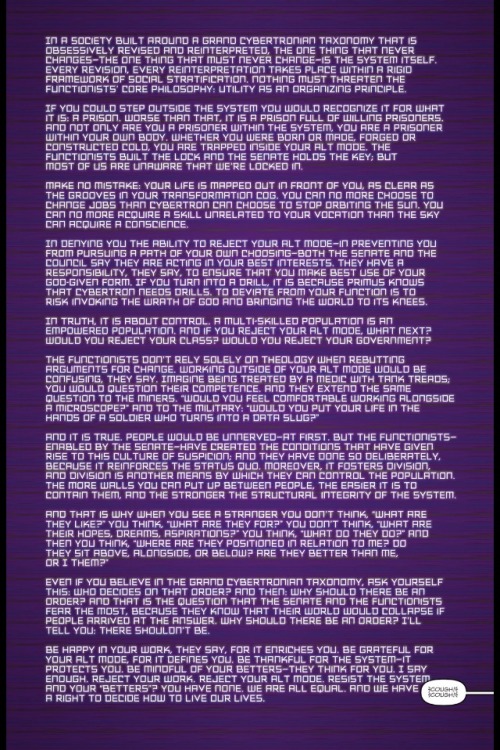
IDW Transformers comics - Megatron's assessment of 'Functionist' society with strong ties to pre Revolution Russia - form dictates function - you can't ascend any higher from wherever you were born - everyone has a specific place in the system - your whole life is determined before you know you have the ability to make a choice

Link 80s miner strikes to themes of miners in the characters of Megatron and Terminus
The introduction of education as a commodity - having to pay to become useful


This symbols narrative origin is a visual representation of the phrase "you are being deceived"Image result for decepticon logo

Advertising enforces schisms - everyone you see, you think , am I better than them? Are they better than me? - Why should there be an order?

The Institute - brainwashing centre - links to the media today brainwashing people who don't think the right way

Joseph Jacotot reversed the rules

Most of our achievements are fuelled by the feeling of incompetence society and the media enforce

Wednesday, 5 October 2016

The Flipped Classroom - Lecture 5/10/2016

Traditional teaching methods - embeds hierarchy, before you even start to learn you are first told that you are below someone else - teacher

  • Jacques Ranciere - The Ignorant Schoolmaster - application to education
60s origins - disaffected generation that wanted a new world - student occupation of French universities May 1968 
- anti authoritarian & radical - education for all & state funded students 

Students used their creative skills to further the revolution - posters etc
Visual Communication is a WEAPON - doesn't belong in a gallery, belongs out in the world - you can actually buy these prints now, the revolution failed socially but has a legacy in cultural memory

"sous le paves,  la plage" - "under the paving stones, the beach"


We are controlled mentally as much as we are controlled by threat of punishment

Ranciere rebelled against Althusser, his tutor - who was he to tell students they needed him - telling other people how to be free - 'every theory of education is committed to preserving the power it brings to light'

System keeps you in your place - why can't a "worker" want to be more than their social definition 
- Links to The Functionist Council - http://tfwiki.net/wiki/Functionist_Council
Everything is predetermined - feelings/emotions/responses
- self stratifying - people participate and try to label and create a hierarchy that doesn't exist and doesn't need to exist

Joseph Jacotot - gave students French and Flemish copies of a book & left them to it alone - they became able to figure French out alone - it shouldn't be surprising but we expect it to be hard because we are conditioned to think it won't work if it doesn't conform. Everyone teaches themselves about language and the world.
There is no divide - we don't need them, they need us to turn up and not riot so that they get paid.
  • Society of contempt - people are individualist and judgemental - The lecturer who thinks he is better is equally wrong and ignorant as the too cool for school student
  • University fees = the commodification of knowledge
We are customers of our universities - our education is the equivalent of a sofa or a washing machine or a bag of haribo

Stultification - Repression 
Self Education - Emancipation


Wednesday, 4 May 2016

End of Module Evaluation


Leeds College of Art
BA (Hons) ILLUSTRATION
Level
04
OUIL401Context of Practice
Credits
20
End of Module Self Evaluation

NAME
ISAAC SMITH


1.  What skills have you developed through this module and how effectively do you think you have applied them?

I feel that I have developed a strong sense of how to look deeper into an illustration and identify contextual factors that might be at play within the choices of composition and colour, and how they define what the image is trying to convey. I also think I have gotten better at applying knowledge of the time and place an illustration was made within my analysis of that image, to understand the context of it and how it relates to the world in which it was produced/produced for.


2. What approaches to/methods of research have you developed and how have they informed your practical outcomes?

As my practical outcomes have been very politically driven I have started to keep up with newspapers and online articles to broaden my knowledge of what I’m researching and how I can visually respond to the ideas and topics that are present in today’s politics. I have also been watching debates and speeches on television to try and get a more direct presentation of the issues without it being filtered through a reporter first.


3. What strengths can you identify in your work and how have/will you capitalise on these?

I am happy with my essay as I feel that I used my research to flesh out the ideas I wanted to discuss, and I enjoyed the process of putting the essay together and exploring my theme, as ideas of social and political change in regard to illustration is something I have always been interested in and look forward to exploring further now I have a better knowledge of it in the context of specific examples from the last few decades.


4. What weaknesses can you identify in your work and how will you address these in the future?

I found it difficult not really having a finished product to work towards, so I need to improve my skills at developing work as much as I can without the aim of making a final piece at the end of that development. I also would utilise the library more as a lot of my research has been based online. I think I generally need to be just as exhaustive as possible to make better and more refined work in the future.


5. Identify five things that you feel will benefit you during next years Context of Practice module?
- Visual Journal
- Blogging regularly
Research
Being more openminded to new ideas and techniques
Developing work without a finished outcome in mind


6.How would you grade yourself on the following areas:
(please indicate using an ‘x’) 

5= excellent, 4 = very good, 3 = good, 2 = average, 1 = poor

1
2
3
4
5
Attendance


x


Punctuality


x


Motivation


x


Commitment


x


Quantity of work produced


x


Quality of work produced


x

Contribution to the group


x

The evaluation of your work is an important part of the assessment criteria and represents a percentage of the overall grade. It is essential that you give yourself enough time to complete your written evaluation fully and with appropriate depth and level of self-reflection. If you have any questions relating to the self-evaluation process speak to a member of staff as soon as possible.


A copy of your end of module self evaluation should be posted to your studio practice blog. This should be the last post before the submission of work and will provide the starting point for the assessment process. Post a copy of your evaluation to your COP blog as evidence of your own on going evaluation.


Notes

Visual Evaluation

The above presentation is a visual summary of my contextual and practical work and research that are the product of this module. 

Finished Essay

Saturday, 30 April 2016

Developed designs - Vis Journal

I have found it really difficult trying to fill my visual journal with ideas whilst not actively working towards a finished product or end of a brief as I'm used to with the other modules. I wanted to experiment with colour outside of my sketchbook and try to elaborate on some of my visual ideas with more focused and finished illustrations, as most of my work inside my book has been investigative and idea driven, rather than visually focused.
Keeping with the theme of destruction I chose to just elaborate on some ideas of Trump as an over the top violence obsessed lunatic, and express this in vibrant colour. To do this effectively I chose to use Promarkers, which give a rich colour but don't lose tone and vibrancy like some digital work does. I very much enjoyed using this method and it's one I'll definitely carry over into my other work.

Sunday, 24 April 2016

ihateyoutrump ihateyoutrump ihatehatehateyoutrump

The only reason I'm trying with all my might not to utterly hate Donald Trump after cartooning him for weeks is that I'm now 96% certain that hatred is his actual power source like the sun is for the rest of us, and I don't want to make him any stronger.
I feel that I have had a unique opportunity having this project align with the 2016 Presidential elections, as I've had the chance to experiment with caricature on someone who truly deeply deserves the mockery.
Trump's entire manifesto is focused around "Make America Great Again!". To me this speaks of a man who wants to take the country backwards rather than into the future. Slowly but surely over the past couple of years, acceptance of different races, religions, sexuality, and opinions has been on the rise. Nowhere near to the level it should be, but big steps in the right direction have been made, such as US Congress legalising gay marriage last year for one. Trump is entirely against this progression and wants to go backwards to some idealistic 1950s period where men were men and women were women and everyone was white and happy with an electric lawnmower and cherry pies for dinner. That is absolutely fucking bizarre.
The core mission of his campaign is one of destruction, tearing down the liberal world in favour of a "strong" one. How one country versus every other country on the planet is stronger than a unified planet, I cannot get my head around. His envisioned America is also fully equipped with a wall at the southern border, designed to keep Mexico and South America out of the US, and also be paid for by Mexico. Following the Paris attacks, he suggested a nationwide database be constructed containing all the information for every Muslim in the United States. This all sounds like I'm confusing real life with comic book narratives but it's all true which is far more terrifying.
PLUS RIGHT
The United States is a country of immigrants and since its Western discovery it always has been. The Native Americans were killed and overtaken by immigrants that eventually led to people like Donald Trump who feel they have some God given right to the land, when they don't, they took it with bullets and force, and those are the methods he sees fit to keep using to maintain it.

Researching Trump has been eye opening and also pretty awful, so I've enjoyed deconstructing his character and message into the ridiculousness that it is, whilst not overlooking that it is a dangerous time in our history when such ridiculousness could become the basis for the most powerful office on the face of the planet.
I wanted to express Trump as a destructive force in my illustrations, or at the very least, visually disgusting in some way.

Thursday, 3 March 2016

Visual Journal - I'm enraged and laughing simultaneously I don't feel good

I think I've found my target.
Who?
Well..


I thought the best way to try to understand the importance of caricature and cartooning political issues would be to just do it in relation to something that I personally take issue with. Namely, this escaped pig that has shoved its head into an old pumpkin and entered the US Presidential Campaign.

This video of Trump fans being unknowingly read Adolf Hitler quotes brings me to a state of combined anger and laughter that makes me feel physically ill. What better feeling to direct in a creative outburst, right?
https://www.youtube.com/watch?v=5NzhQWcc7h4


Thursday, 11 February 2016

Visual Journal - first ideas

I'm focusing on character based propaganda and cartoons for my visual work. I'm not sure how I want these ideas to be finalised yet but I'm enjoying churning out some characters relating to politics. I have mainly focused on trying to basically illustrate political concepts, such as militarism, the perceived strength of armies, and the nonchalant nature our governments appear to take in regard to environmental safety. 
The inspiration for these personified characters comes from the classic Disney design values present in Fantasia:
                                
For these sort of characters, I want to keep away from using faces as a limitation to see how else I can respond and express personality using just arms and legs.

Thursday, 4 February 2016

Practical Work Proposal

I plan to to keep on investigating propaganda as the essay has led me to really interesting topics. I am motivated to demonstrate the frustration and emotion that is evident within the comics I have already analysed. I intend to look at wartime comics and how they have developed. I am quite interested in the characters within the comics but this area requires more development. Inventing original characters is what I hope to lead to by investigating past and current characters. I should use more comic aesthetics in my work such as more colour because previously I have stuck to line and monochrome colours. Also, I want to research more propaganda and how it relates to comics e.g. Vietnam, Red Son etc.
I plan to use a varied range of material to develop my ideas. I want to introduce a narrative to the characters which would in turn make the messages have more depth.

Wednesday, 13 January 2016

Postmodernism - Links to my question - The Man of Tomorrow VS The Dark Knight


  • Modernism - born out of optimism - post war utopia
  • Becomes blind, follows rules without question, Form Follows Function
  • Modernism is: Innovative, Individual, Serious
  • Post-Modernism is: Pessimistic, Disillusioned, Chaotic, Parody
In relation to my question, I think the point in the lecture when I feel I grasped the nature of Modernism and Post-Modernism was the example of comparing fictional comic book cities Metropolis and Gotham (obviously the only way I could understand it was through being a nerd). 

Metropolis is a clean futuristic haven protected by Superman, the brightly coloured ever-smiling curly haired hero with every power under the sun (that's a good pun for Superman readers trust me). It represents everything about innovation and progress, constantly looking to the future and development. One of Superman's titles is even "The Man of Tomorrow". The only threats to the city are usually alien, and the only prominent evil the city seems to have produced is Lex Luthor, who is still an expert at making the public deem him one of the good guys.

Conversely, Gotham is a fucking hellhole. The only defining trait of Gotham that surpasses the criminals is the vigilante who knocks all their teeth out, the Batman. The opposite of Superman, operating in darkness and never revealing his face, known as "The Dark Knight". Gotham is pessimism personified, a perpetually dark dystopia that's only defence from total chaos is the brutal enforcement of Batman. 

Metropolis and Gotham are useful examples of Modernism and Post-Modernism, existing as polar opposites with opposite narratives, characters, and visual design. These two cities are shaped around their respective heroes, or the heroes are shaped around the cities. Superman would never be a compelling character in Gotham, because he could find any number of elaborately placed bombs within seventeen seconds and then freeze breath the Joker into a block of ice and kick him into the sun. Just as Batman could never be a compelling character in Metropolis, as someone like Doomsday (pictured below) could rock up (that's a good pun also) and punch Batman through the core of the Earth with the effort a normal person would use to accidentally crush a snail. I think this defines the contrasting nature of modernism and post-modernism at least in a narrative and thematic sense.

I wanted to post about my thoughts towards this primarily because I have focused on Watchmen in my essay, which is set in an alternate universe America that is basically Gotham on a nationwide scale. What I now understand about Postmodernist values has helped me better understand the setting of Watchmen and its contextual importance as a commentary on the disillusionment with capitalist-focused ideas of progress and innovation.